
Startup Funding Brief · October 5, 2026 · 4 min read
Robot Software and AI Agents Attract Billion-Dollar Bets This Week
Three infrastructure-layer rounds totaling over $2.1B signal that investors are backing the picks-and-shovels plays in physical AI and autonomous agents, not just the hardware.
Software Beats Hardware in Robotics Funding
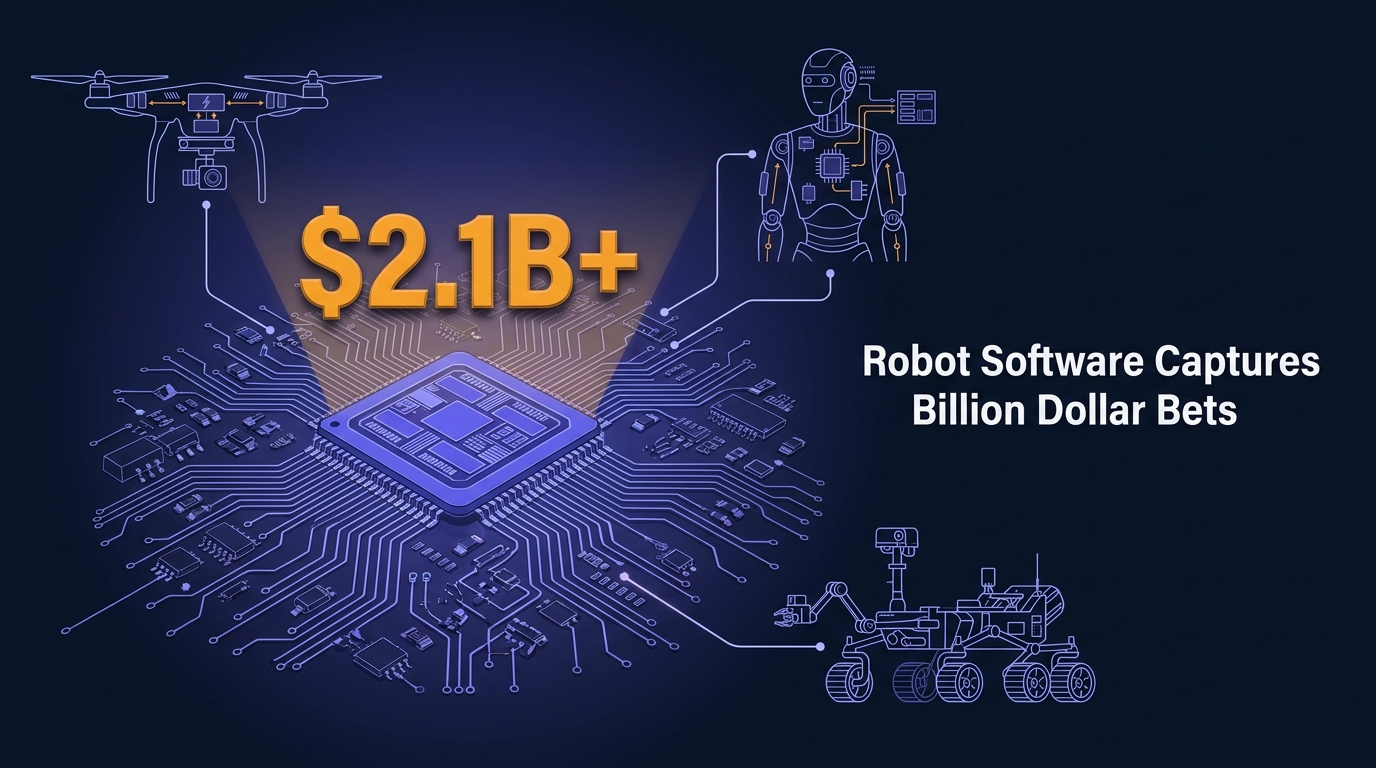
Two of the week's largest robotics rounds went to companies that build none of the machines their software runs. FieldAI, a California-based startup that sells a general-purpose operating system for humanoids, drones, and rovers, is set to raise $700 million at a $10 billion valuation, as The Next Web reported — a five-fold increase from its mark just over a year ago [1]. On September 17, D-Robotics closed a $400 million Series C led by Mirae Asset, with strategic participation from Meituan and backing from Hillhouse, Temasek's Vertex Growth, and others, according to Robot Belt [3]. D-Robotics makes chips — specifically a processor that integrates brain and motor control on a single board — but it does not manufacture robots.
The pattern is deliberate. Investors appear to be betting that the robotics market will replicate the dynamics of cloud computing, where the chip and operating-system layer captured more durable margin than the device makers. For founders raising in physical AI or industrial automation, this is a signal about where institutional capital sees defensibility: at the interface between intelligence and hardware, not in the hardware itself. What is not yet clear from either round is whether this software-first margin thesis holds once large robot manufacturers begin building proprietary stacks of their own [1][3].
A $1B Agent Round in Roughly One Month
Instinct, a San Francisco personal-agent startup, closed a $1 billion Series C at a $10 billion post-money valuation on September 28, with Sequoia Capital, Benchmark, and Coatue leading, as aisheetreport.com reported [2]. The round represented approximately a 4x markup in roughly a month. The product is invite-only, operates via SMS and phone calls rather than a dedicated app, and has reportedly booked half of its $1 billion in gross merchandise value through travel transactions.
The distribution approach is notable. By routing through SMS and voice rather than a proprietary interface, Instinct inserts itself between consumers and the platforms — airlines, hotels, booking services — that currently own those transactions. The source describes this as a distribution threat for consumer-facing small businesses [2]. For founders building consumer or SMB-facing AI agents, the Instinct round suggests that tier-one investors are willing to price conviction at an extreme premium when an agent demonstrates real transaction volume, not just engagement. The risk, which the round does not resolve, is whether SMS-based distribution holds when platforms begin blocking or competing with it directly.
Early-Stage AI Tools Still Closing Rounds on Metrics
Not every round this week was measured in billions. Hestus, a Y Combinator-backed startup founded by former Cruise engineers, raised $7.4 million to build an AI autocomplete layer for CAD tools including Autodesk Fusion 360 and SolidWorks, according to Startuply.vc [4]. The company reports 5,000 mechanical engineer users — a concrete adoption figure in an enterprise segment where switching costs are high and workflow integration is genuinely difficult.
The Hestus raise is a useful counterpoint to the mega-rounds above. At pre-seed and seed stage, a specific user count in a defined professional category still drives conviction. Mechanical engineering CAD is a narrow enough market that 5,000 active users is meaningful signal, not noise. What is not disclosed is revenue or retention, so it is not possible to assess whether the product has crossed from trial to dependency [4].
AI Token Costs Are Changing Which SaaS Customers Are Worth Keeping
Separate from the funding news, The Next Web surfaced a structural shift that matters to any founder running an AI-native SaaS product: the per-customer cost structure is no longer flat [5]. For roughly two decades, adding a SaaS seat cost nearly nothing to serve. Now, every user action that triggers a model call burns tokens and compute, meaning high-usage accounts that looked profitable on a seat-revenue basis may be loss-making on a unit-economics basis — and most finance teams, as The Next Web reported, discover this a quarter too late.
Vayu, the company profiled in that piece, is building real-time revenue intelligence tools specifically to surface this problem for CFOs [5]. The product is less relevant here than the underlying dynamic: if you are raising a seed or Series A on the strength of revenue figures that do not account for per-customer inference costs, investors who understand this shift will ask. Founders raising on AI-native SaaS right now should be able to speak to gross margin by customer cohort, not just by product tier.
This week, if you are raising
- If you are raising in robotics or physical AI, position your company explicitly at the software or chip layer and be prepared to explain why hardware manufacturers will not build what you build — investors are pricing that question into these rounds.
- If you are pitching an AI agent product, bring transaction or GMV data to your investor conversations, not just user counts; the Instinct round shows that top-tier firms are underwriting real economic throughput, not engagement metrics.
- If you are running an AI-native SaaS product, calculate your gross margin by customer cohort before your next investor meeting — know which accounts are profitable after inference costs, because investors who have seen the Vayu thesis will ask.
Sources
 [1]Robot software startup FieldAI is set to raise $700M at a $10B valuationthenextweb.com
 [2]Instinct closes $1B Series C at $10B, agent books half its…aisheetreport.com
 [3]D-Robotics just raised USD 400 million without building a single robotrobotbelt.com
 [4]Startuply.vc: Hestus Puts Autocomplete Into the Hands of 5,000 Mechanical Engineersstartuply.vc
 [5]AI broke the economics of software. Vayu wants to be the first to tell a CFO which customers are losing them moneythenextweb.com