
Startup Funding Brief · October 3, 2026 · 4 min read
Physical AI Attracts Institutional Capital While SaaS Unit Economics Shift
Three rounds closed in a week reveal where investor conviction sits this quarter: hardware-adjacent AI platforms, proven supply chain automation, and intelligence that makes per-customer profitability visible.
Physical AI Crosses the Institutional Threshold
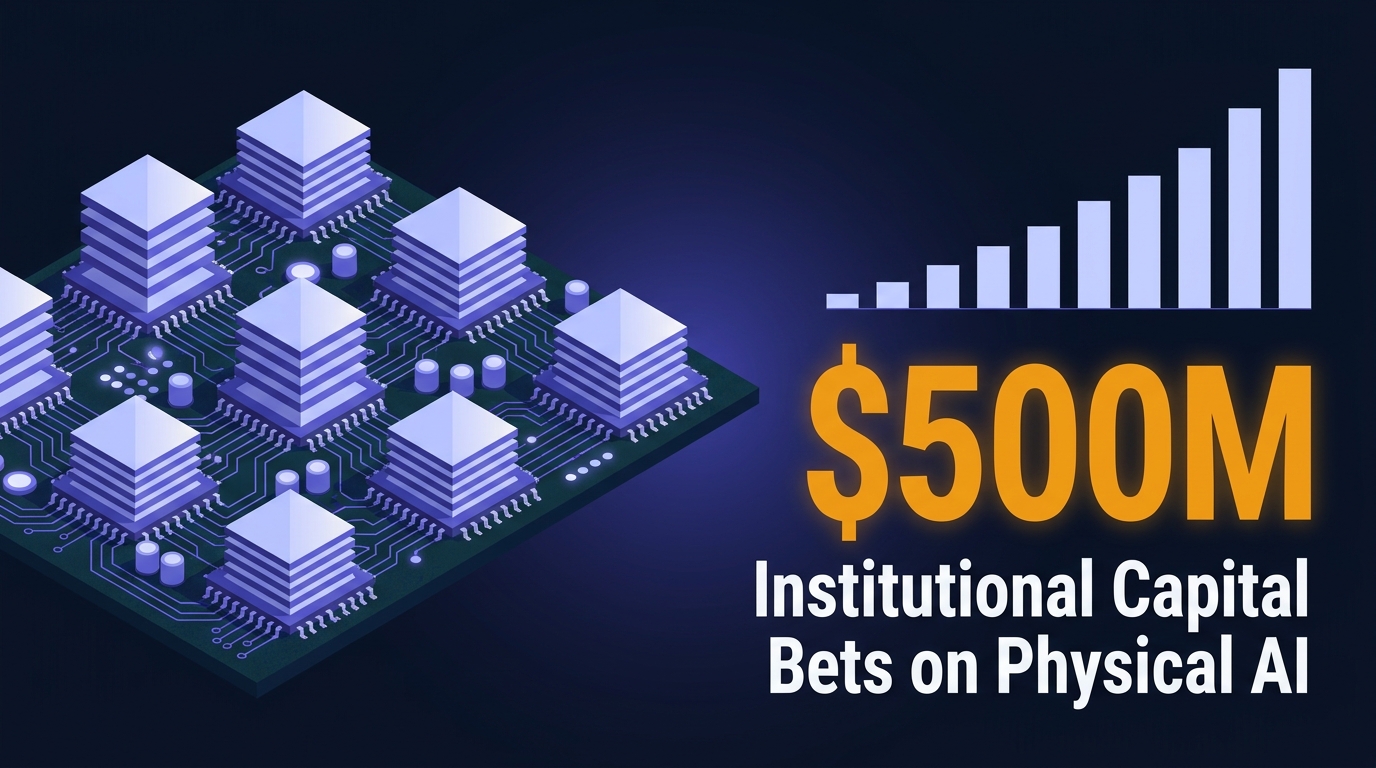
SiMa.ai closed a $150 million Series C at a $1.45 billion valuation, bringing its total capital raised to $500 million, as cxotoday.com reported. The round was oversubscribed and co-led by Fidelity Management & Research Company and Amplify, with AllianceBernstein, Baron Capital, and J.P. Morgan joining as new investors [1]. The presence of those names matters: these are not specialist deep-tech funds taking a speculative position. They are large asset managers allocating at scale, which signals that physical AI has moved from a niche thesis into a category institutional capital is willing to price and hold.
YourStory noted that Dell Technologies Capital also participated, alongside StepStone Group and Alter Venture Partners [4]. The combination of corporate strategic money from Dell and traditional growth equity from Fidelity in the same cap table suggests the market is pricing physical AI platforms as both infrastructure plays and enterprise software bets simultaneously. For founders building at the intersection of edge hardware and agentic software, that dual framing is worth understanding when positioning your round.
Supply Chain Automation Earns a Series A on Results Alone
Atomic, an AI-native supply chain planning platform founded by former Tesla supply chain leaders, raised a $12.5 million Series A led by Klass Capital and Madrona, as PRNewswire reported [3]. The company's pitch was not speculative. Atomic already automates 90 percent of purchasing for DoorDash's DashMart operation and helped Good Chop cut inventory in half while more than doubling revenue. Those are outcomes a CFO can verify, and they appear to be exactly what moved institutional investors to commit.
The round is a useful reference point for seed and early Series A founders in industrial or operations software. Investors in this environment are rewarding demonstrated customer results over market-size arguments. Two named enterprise customers with quantified outcomes — not a pipeline of pilots — appear to have been the deciding factor here. If you are raising in a vertical with long sales cycles, showing what one or two customers have already achieved may carry more weight than projections.
The $2 Billion Acquisition Benchmark in AI Research
Salesforce signed a definitive agreement to acquire Listen Labs, an AI customer research startup, in a deal reported at approximately $2 billion, according to SiliconAngle [5]. Business Insider had surfaced the negotiations three weeks earlier, suggesting the process moved relatively quickly once talks became public. The price was not officially confirmed by either party, so founders should treat it as a reported figure rather than a disclosed one.
What the deal does confirm is that large software companies are paying strategic premiums for AI capabilities that sit close to their core workflows — in Salesforce's case, customer intelligence. For founders building AI tools adjacent to major CRM or revenue platforms, this acquisition sets a reference valuation that will inevitably surface in investor conversations. It also reinforces that acqui-hire is not the only exit path; product-led acquisitions at genuine scale are still happening.
A Structural Shift in SaaS Unit Economics
Separately from any single round, The Next Web reported on a problem Vayu is now building around: AI inference costs have broken the unit economics that made SaaS scalable for two decades [2]. When serving a customer cost almost nothing, a seat was pure margin. Now every customer action burns tokens and compute, and most finance teams do not find out a large account was unprofitable until a quarter after the fact.
Vayu's Revenue Intelligence Hub is designed to show per-customer profitability in real time. Whether or not Vayu specifically succeeds, the underlying dynamic it is responding to affects any SaaS founder who has added AI features to their product. If your gross margin assumptions were built before you integrated a model into your core workflow, they may no longer hold. Investors at the seed and Series A level are beginning to ask about AI cost per customer, and founders who cannot answer that question with current data are at a disadvantage in due diligence.
This week, if you are raising
- If you are raising for a physical AI or edge hardware platform, prepare for investor questions about both enterprise software and infrastructure framing — SiMa.ai's cap table shows institutional money is now comfortable holding both theses at once.
- Before your next investor meeting, calculate your AI inference cost per active customer and express it as a percentage of gross margin — this has become a diligence question, and the founders who can answer it precisely will move faster through term sheet conversations.
- If you have one or two customers with results you can quantify in hard operational terms — cost cut, inventory reduced, revenue increased — lead with those outcomes rather than total addressable market figures; Atomic's Series A shows that documented results are closing rounds right now.
Sources
 [1]SiMa.ai Reaches $1.45B Valuation with $500 Million in Total Funding to Scale Physical AI in Humanoids, Automotive, and Dronescxotoday.com
 [2]AI broke the economics of software. Vayu wants to be the first to tell a CFO which customers are losing them moneythenextweb.com
- [3]Atomic Raises $12.5M to Build the AI Control System for Physical Goods Companiesprnewswire.com
 [4]Physical AI startup SiMa.ai raises $150M in Series C | YourStoryyourstory.com
 [5]Salesforce to acquire AI customer research startup Listen Labs in reported $2B deal - SiliconANGLEsiliconangle.com