
Startup Funding Brief · October 12, 2026 · 4 min read
Hardware and AI Raises Surge as Valuations Climb Fast
Four rounds totaling over $2 billion this week reveal where investor conviction is concentrating — and what it means for founders building in AI and deep tech.
The numbers reshaping expectations
Four companies disclosed major rounds in the past week: TypeSafe AI raised $870 million at a $7.5 billion valuation just weeks after launching its Jev model, as TechCrunch reported [3]. Positron pulled in $875 million to build AI inference chips that run on consumer-grade memory rather than expensive high-bandwidth alternatives [4]. Atomic Machines emerged from six years of stealth with $250 million already in hand and a product shipping to data center customers, according to Startup Fortune [2]. Flow Engineering closed a $50 million Series B at a $750 million valuation for its agentic AI platform targeting hardware development, with Sequoia, Valor Equity Partners, and Atreides Management among those writing checks [1].
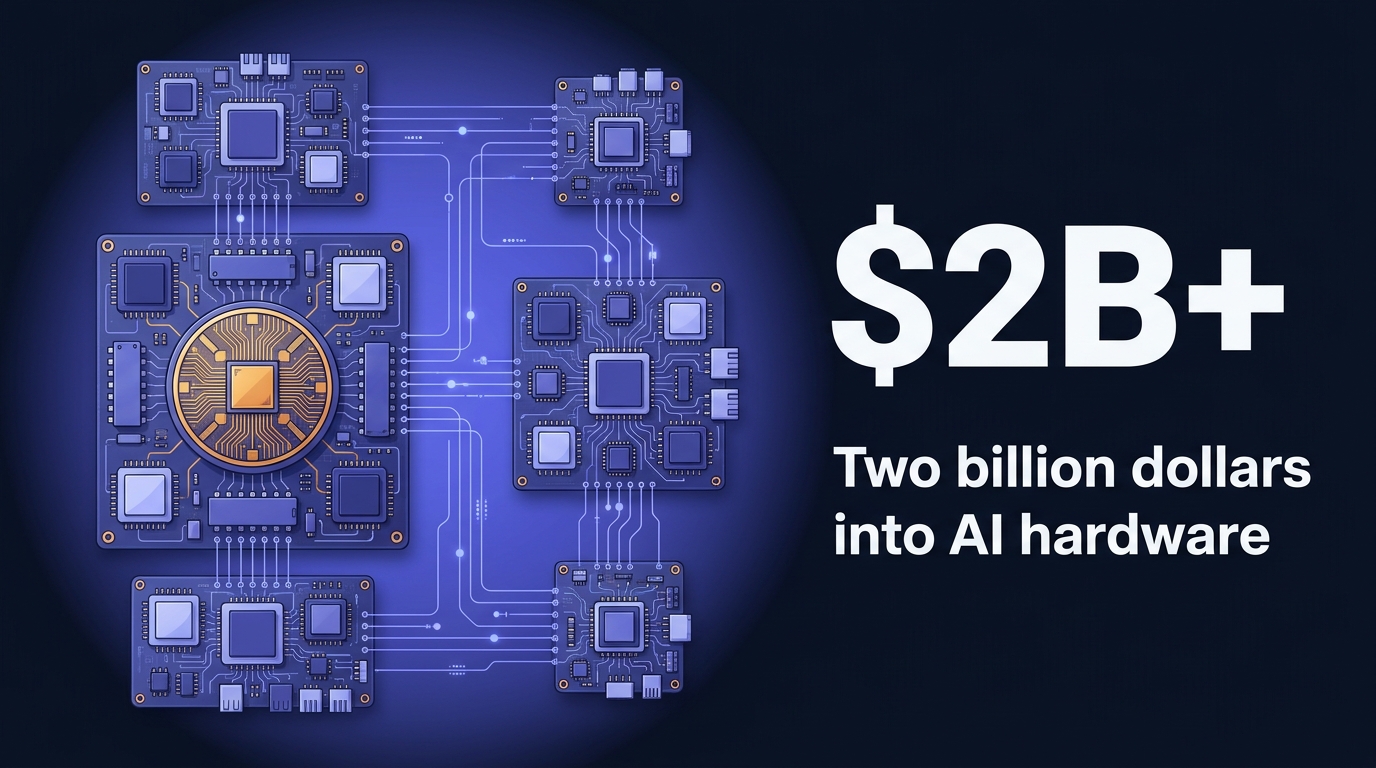
Combined, these four rounds represent more than $2 billion deployed into a narrow band of sectors — AI inference infrastructure, molecular-scale manufacturing, and AI-assisted hardware tooling — inside a single week. That concentration is a signal, not noise. Investors are not spreading bets broadly; they are making large, focused commitments to companies attacking specific bottlenecks in the AI supply chain.
Speed and stealth both working
TypeSafe AI's trajectory is the most striking. As Enterprise AI reported, roughly one-third of Fortune 500 companies are already using Jev, which is designed for task automation rather than text generation [5]. The company reached a $7.5 billion valuation within weeks of launch — a pace that signals investors moved on adoption evidence, not a roadmap. Andreessen Horowitz led the round, with Sequoia participating alongside existing investor DCVC [3].
At the opposite extreme, Atomic Machines spent six years in stealth before surfacing. Its founder, Jeff Holden — who built Amazon Prime and later served as Uber's first product chief — was running a company that describes its technology as a compiler for physical matter. Its first shipping product, the PrimeSwitch PS-150, is already in the hands of early-access data center customers [2]. The $250 million raise suggests investors were patient because the technical moat being built required time that could not be compressed.
The lesson for founders is not that one path is better. It is that investors are currently comfortable with both: rapid product-market fit validation and long-horizon deep tech construction. What appears non-negotiable in both cases is tangible evidence — either real enterprise usage or a product already shipping.
Infrastructure scarcity is a thesis, not a feature
Positron's raise deserves particular attention from founders thinking about positioning. The company is not building a faster version of existing AI chips. It is explicitly addressing a scarcity problem: high-bandwidth memory is expensive and constrained, so Positron's inference accelerators are designed around consumer-grade memory instead [4]. That is a bottleneck argument — the same logic that has powered successful raises in energy, data center cooling, and networking.
Flow Engineering is making a related bet at a different layer. Hardware development is slow and expensive, and an agentic AI platform that can compress that cycle has a clear customer base in semiconductor and electronics companies [1]. The $750 million valuation on a $50 million Series B implies investors believe the market for AI-assisted hardware tooling is large, even if the company is earlier in its commercial trajectory than the others disclosed this week.
What this week's rounds do not tell you
The items do not disclose revenue figures for Flow Engineering, Positron, or Atomic Machines, so it is not possible to assess valuation multiples for three of the four companies. TypeSafe AI's Fortune 500 adoption claim is significant, but the items do not specify whether that usage is paid or in trial, which matters when evaluating how durable the $7.5 billion figure is [5].
It is also worth noting that all four of these companies are operating in sectors with very high capital requirements — chips, molecular manufacturing, and frontier AI models are not areas where lean operation is the norm. Founders in these categories should not read these rounds as a signal that the bar for raising has dropped; they should read them as a signal that when the case is compelling, investors will commit at scale.
This week, if you are raising
- If your startup addresses a documented supply constraint — in chips, memory, manufacturing, or AI tooling — frame the round thesis around the bottleneck you remove, not just the technology you have built.
- Investors backed both a weeks-old company with Fortune 500 traction and a six-year stealth company with a shipping product, so prioritize whichever form of concrete evidence your stage allows — usage data or a working product in customer hands.
- Before your next investor meeting, identify which of this week's funded categories — AI inference infrastructure, hardware development tooling, or novel AI model architectures — your work touches, and prepare a specific answer for how your capital requirements compare to the large rounds now setting expectations in your sector.
Sources
 [1]Flow Engineering Raises $50 Million Series B At $750 Million Valuationpulse2.com
 [2]Atomic Machines exits six years of stealth with $250 million and a compiler for matter - Startup Fortunestartupfortune.com
- [3]The maker of non-text AI model Jev valued at $7.5B just weeks after launch | TechCrunchtechcrunch.com
 [4]Positron raises $875M for inference chips using consumer memory — Die Signaldiesignal.com
 [5]TypeSafe AI Secures $870M Funding at $7.5B Valuation for Revolutionary Non-Text AI Model Jev, ETEnterpriseaienterpriseai.economictimes.indiatimes.com