
Startup Funding Brief · September 23, 2026 · 4 min read
AI Infrastructure Draws Five Large Rounds in One Week
From memory chips to data labeling, investors are writing checks well above $200M for every layer of the AI stack, reshaping what 'infrastructure' means for founders raising now.
The week's numbers in context
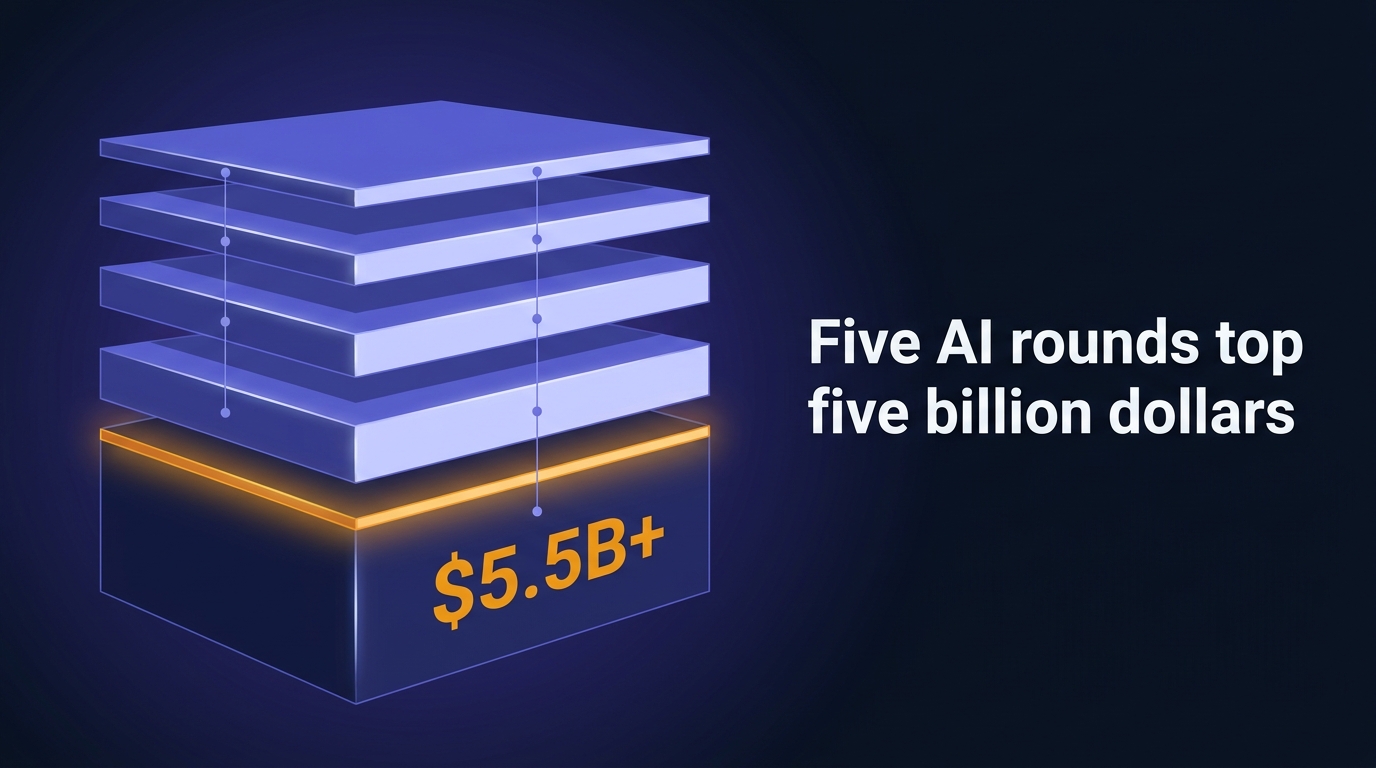
Five rounds closed or announced in roughly five days: Crusoe at an anticipated $3.9 billion Series F [2], Snorkel AI at $350 million [3], Positron AI at $875 million [4], Cornelis at $205 million [5], and Factory at $200 million [1]. Taken together, that is more than $5.5 billion committed to companies working on compute, memory, networking, data, and AI-native software in a single week. The pace is not normal, and founders raising at any stage should understand what it signals before they step into investor conversations this quarter.
The rounds span multiple layers of the stack deliberately. Investors are not crowding into one category — they are betting that the entire infrastructure beneath foundation models remains undersupplied. That logic has direct consequences for how VCs evaluate market-size claims and competitive positioning in pitches right now.
What is pulling the largest checks
The two largest rounds went to companies attacking physical constraints in AI compute. Positron AI closed an $875 million Series C at a $5 billion valuation on the thesis that LPDDR memory architecture can outperform the high-bandwidth memory Nvidia ships with its GPUs, framing bandwidth to memory — not raw processing power — as the real bottleneck in inference workloads, as pbxscience.com reported [4]. Crusoe, which provides AI compute infrastructure, announced the initial close of a round expected to reach $3.9 billion at a $30.9 billion valuation, with Nvidia itself participating, according to Channel Insider [2]. Nvidia backing a company that sells capacity built around GPU clusters is a signal about where demand is heading, not just an endorsement of one startup.
Cornelis raised $205 million to launch what it describes as Active Compute Fabric, an open networking architecture that embeds programmable compute directly into the interconnects linking AI systems at scale, as Pulse2 reported [5]. The argument is that networking is no longer passive plumbing; it is a place where computation can happen. That framing — turning a cost center into a differentiated layer — is exactly the kind of narrative that attracted this round.
Data and software attract serious capital too
Snorkel AI closed $350 million at a $3.5 billion valuation in a round co-led by Insight Partners and S32, with participation from Addition, Greylock, March Capital, Blumberg Capital, Allegis Capital, Frontline, Standard, and Third Point Ventures, according to a company press release [3]. The breadth of that syndicate — established growth funds alongside earlier-stage names — suggests investors see data infrastructure as a durable category, not a transitional one that gets absorbed once foundation models improve.
Factory's round is the outlier in this group because it sits closest to the application layer. The AI coding-agent company raised $200 million at a $5 billion valuation, up from $1.5 billion five months earlier, with backing from Blackstone and Salesforce CEO Marc Benioff as an angel, as theterminal.space reported [1]. That is a more than three-times increase in valuation in under half a year, and it is the company's third large check in under twelve months. The speed of re-marking suggests investors are competing for allocation, not deliberating over it.
What this means if you are raising pre-seed through Series A
The visible rounds this week are all late-stage, but the dynamics they create reach earlier in the funnel. When large funds deploy hundreds of millions into infrastructure bets, they need portfolio companies at every layer to succeed for the thesis to pay off. That creates downstream demand for early-stage companies that sell to, integrate with, or reduce costs for the Crusoes and Snorkels of the market. A pre-seed or seed founder who can articulate a credible relationship to the infrastructure build-out — as a customer, a tooling layer, or a distribution channel — is speaking directly to what investors are tracking this quarter.
The Factory re-rating also sets a benchmark that cuts both ways. Investors who missed that round, or who passed on similar companies at lower valuations, are sensitized to moving faster. But the same data point raises the bar on what 'fast growth' means in AI software. If a $1.5 billion company can become a $5 billion company in five months, investors will ask founders raising Series A rounds why their trajectory does not look similar. Be prepared to answer that question with specifics, not projections.
This week, if you are raising
- Map your startup to a specific layer of the AI stack — compute, memory, networking, data, or software — and use this week's rounds to show investors you understand where capital is concentrating and why your position benefits from it.
- If you are in AI software or tooling, prepare a concrete answer to valuation velocity questions: Factory's five-month, three-times re-rating will prompt investors to ask why your growth curve looks the way it does.
- Study the Snorkel AI syndicate structure — co-leads from Insight and S32 alongside seven other named participants — as a template for how to think about building a round with both institutional anchors and strategic smaller checks rather than chasing a single lead investor.
Sources
[1]Factory Raises $200M at $5B Valuation, Triples in 5 Monthstheterminal.space
 [2]Crusoe Announces Initial Close of Anticipated $3.9B Round as Nvidia Backs AI Infrastructure Pushchannelinsider.com
 [3]Snorkel AI Raises $350M to Scale the Data Factory for Frontier AIprnewswire.com
 [4]Skipping HBM: Positron Raises $875M to Prove LPDDR Can Outrun Nvidia's Memory Bottleneckpbxscience.com
 [5]Cornelis Raises $205 Million And Launches Active Compute Fabric For Scale-Up And Scale-Out AI Networkingpulse2.com